RD-blog-number-2461 by Herb Zinser
Gravity architecture history
Earth has a gravity field that interacts with atomic mass. A theorist could consider some EVENTS and happenings on EARTH as gravity expressions of the GRAVITY FIELD. Since the gravity field interacts with atomic MASS, it may have a major influence on life.
Let’s assume for the moment ….that gravity is the major influence, gravity has thoughts, and gravity grammar…gravity language exists.
|
|
Gravitational Constant |
|


|
|
|||||||||||||
|
|
|
|
|
|
|
||||||||
|
|
|
The constant G appearing in Newton’s law of gravitation, also known as the universal gravitational constant,
where F is the force between two masses m and M a distance r apart. The numerical value of g is
|
|
||||||||||






Thus…we see that G and God are closely related.
What is the God equation?
G + o + d –> gravity objects data …is one possible perception.
Let’s look at 2 major expressions of G = Gravity …that some consider like the work of God.
G expressed thru the physical buildings in Gothic architecture in Europe.
Gothic architecture
From Wikipedia, the free encyclopedia
Jump to: navigation, search
See also: Gothic art
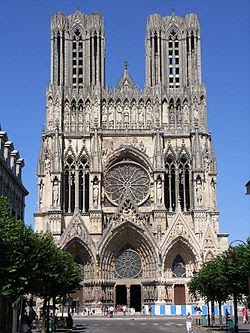
Façade of Reims Cathedral, France
Gothic architecture is a style of architecture that flourished during the high and late medieval period. It evolved from Romanesque architecture and was succeeded by Renaissance architecture.
Originating in 12th century France and lasting into the 16th century, Gothic architecture was known during the period as “French work” (Opus Francigenum), with the term Gothic first appearing during the latter part of the Renaissance. Its characteristic features include the pointed arch, the ribbed vault and the flying buttress.
Gothic architecture is most familiar as the architecture of many of the great cathedrals, abbeys and churches of Europe. It is also the architecture of many castles, palaces, town halls, guild halls, universities and to a less prominent extent, private dwellings.
It is in the great churches and cathedrals and in a number of civic buildings that the Gothic style was expressed most powerfully, its characteristics lending themselves to appeal to the emotions
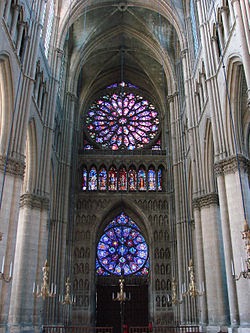
The interior of the western end of Reims Cathedral
Gothic architecture is a style of architecture that flourished during the high and late medieval period. It evolved from Romanesque architecture and was succeeded by Renaissance architecture.
Gothic architecture
Gothic architecture
G ……… architecture
Gravity architecture
What other signals has GRAVITY sent the human ….that is …… the subset human who lives embedded with the EARTH’s gravity field.
Constantinople
Constantinople was the capital city of the Eastern Roman or Byzantine Empire, the Latin and the Ottoman Empire. It was founded in AD 330, at ancient Byzantium as the new capital of the Roman Empire by Constantine the Great, after whom it was named
Thus the signal
G –> universal gravitational constantinople
It was founded …….by Constantine the Great, after whom it was named
It was founded …….by Constant the G –> thus history itself tells us the history of Gravity constant expressions VIA the human messenger .
Gravity forces and thoughts interact with human brain mass …… thus when gravity wishes to SEND a message …. it does so ….. VIA the gravity message output device kn0wn as HUMANOID.
We have covered G –> Gothic architecture which required a lot of work and calculations to implement –> the physical structure as the final result … and then the extended human gravity feelings of those that VIEW the structure or VISIT the structure.
Included in the concept of GRAVITY physical expressions as the primary expression was the city of Constantinople.
The next LEVEL of gravity evolution is reflected by Goethe and the symbolic buildings of his gravity brain.
Goethe –> G + o + et + he –> Gravity order entry hexadecimal …… in year 2013 we have the computer science terminology that allows us to go back and review the human bio-computers that existed in the past.
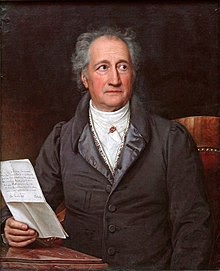
Johann Wolfgang von Goethe
Jo……..Wo….ang…….G
Job….TWo…angstroms Gravity wavelengths
Johann Wolfgang von Goethe (German: 28 August 1749 – 22 March 1832) was a German writer, artist, and politician. His body of work includes epic and lyric poetry written in a variety of metres and styles; prose and verse dramas; memoirs; an autobiography; literary and aesthetic criticism; treatises on botany, anatomy, and colour; and four novels. In addition, numerous literary and scientific fragments, and over 10,000 letters written by him are extant, as are nearly 3,000 drawings.
|
Johann Wolfgang von Goethe |
|
|
|
|
|
Born |
28 August 1749 |
|
Died |
22 March 1832 (aged 82) Weimar, Grand Duchy of Saxe-Weimar-Eisenach, German Confederation |
|
Occupation |
Poet, Novelist, Playwright, Natural Philosopher, Diplomat, Civil servant |
|
Nationality |
|
Nationality |
Germination of cellulose Botany seeds with anti-gravity powers |
Faust
Faust is Goethe’s most famous work and considered by many …
Goethe’s Faust
Goe –> Gravity order entry messages –> Faust
Johann Wolfgang von Goethe‘s Faust is a tragic play in two parts: Faust. Der Tragödie erster Teil (translated as: Faust: The First Part of the Tragedy) and Faust. Der Tragödie zweiter Teil (Faust: The Second Part of the Tragedy). Although rarely staged in its entirety, it is the play with the largest audience numbers on German-language stages. Faust is Goethe’s most famous work and considered by many to be one of the greatest works of German literature.[1]
Goethe completed a preliminary version of Part One in 1806. The 1808 publication was followed by the revised 1828–29 edition, which was the last to be edited by Goethe himself. Prior to these appeared a partial printing in 1790 of Faust, a Fragment.
Goethe finished writing Faust Part Two in 1831. In contrast to Faust Part One, the focus here is no longer on the soul of Faust, which has been sold to the devil, but rather on social phenomena such as psychology, history and politics, in addition to mystical and philosophical topics. The second part formed the principal occupation of Goethe’s last years. It appeared only posthumously in 1832.
Thus we see the symbolic architecture of gravity expressed thru Goethe….who amplified and enhanced the gravity social science signal and gravity social psychology signal.
Thus we see GRAVITY life and its double-helix style of expression: physical and symbolic.